I was a Research Scientist at the Max Planck Institute for Gravitational Physics (Albert Einstein Institute), Potsdam-Golm, and a member of the LIGO Scientific Collaboration.
📄 Download academic CV (PDF) • 🎓 PhD dissertation
Education
- PhD, International Centre for Theoretical Sciences (ICTS), Bangalore, India — advisor Prof. Parameswaran Ajith
- M.Sc, Indian Institute of Technology (IIT) Roorkee, India
- B.Sc, Presidency College, Kolkata, India
Selected awards & recognition
- Honorable Mention, GWIC-Braccini Thesis Prize (2019)
- AWSAR Award, Department of Science and Technology, Government of India (2018)
- Ramakrishna Cowsik Medal, Tata Institute of Fundamental Research (2017)
- Special Breakthrough Prize in Fundamental Physics (2016, LIGO Scientific Collaboration)
- Gruber Cosmology Prize (LIGO Scientific Collaboration)
- Princess of Asturias Award for Technical and Scientific Research (LIGO Scientific Collaboration)
Publications
A full, up-to-date list of my publications is available on INSPIRE-HEP (20+ short-author papers and 20+ collaboration papers with direct contributions).
Landmark publication
Observation of Gravitational Waves from a Binary Black Hole Merger — B. P. Abbott et al. (LIGO Scientific and Virgo Collaborations), Phys. Rev. Lett. 116, 061102 (2016). DOI
Research
For seven years before I became a data scientist, my day job was stress-testing Albert Einstein.
The big question
In 1915, Einstein predicted that gravity isn’t a force — it’s the shape of spacetime itself, bent by mass and energy. A century of careful experiments proved him right, but only in gentle gravity, the kind found around planets and stars. Nobody had tested his equations where gravity gets truly brutal: two black holes, decades more massive than our Sun, spiralling into each other and colliding at a fraction of the speed of light. That changed on 14 September 2015, when the twin LIGO detectors picked up GW150914 — the first gravitational wave ever detected, and the first real chance to put Einstein through his most extreme exam yet.
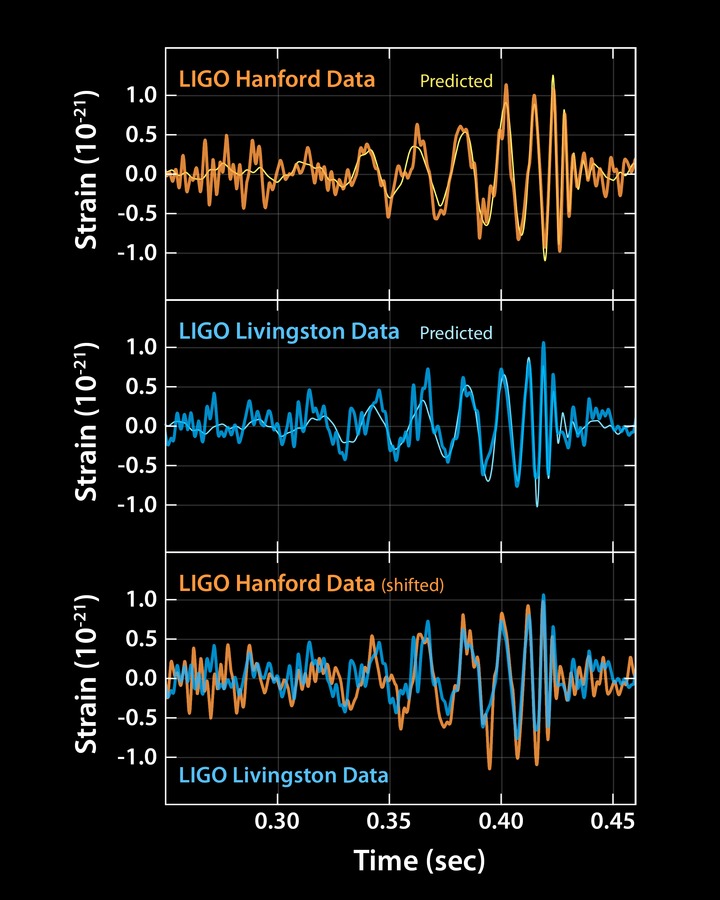 Credit: Caltech/MIT/LIGO Lab
Detecting a gravitational wave at all is absurdly hard — it means measuring a change in distance a few thousand times smaller than a proton, using a laser and two 4 km arms. This comic explains how LIGO actually pulls it off, better than I can in prose:
 Credit: Jorge Cham, PHD Comics
Before and after: a crash-test for black holes
My PhD work — and the test I’m still best known for — is essentially a crash-test for black holes. A collision has two acts: the graceful inbound spiral (the inspiral), and the violent smash-and-settle (the merger and ringdown). Each act, on its own, lets you estimate the mass and spin of the black hole that’s about to form. If Einstein’s equations are correct, the “before” estimate and the “after” estimate have to agree exactly. If they don’t, something in the theory is broken.
I introduced this “inspiral–merger–ringdown consistency test” during my PhD in 2017. It’s since become the LIGO-Virgo-KAGRA collaboration’s standard tool for testing GR on every black-hole merger they detect — including a 2024 paper, two years after I’d left the field, that was still building directly on it.
Listening for the bell tone
A newly formed black hole doesn’t go quiet immediately — it “rings,” radiating away its last wobbles as gravitational waves, the way a struck bell rings at frequencies fixed by its shape and size. General relativity makes an unusually strong claim: a black hole’s ring is dictated entirely by just two numbers, its mass and its spin — nothing else. Much of my later research was spent listening for that ring in real LIGO data, checking it against Einstein’s prediction, and using it to hunt for hints of new physics — extra dimensions, exotic gravity theories, anything that might make a black hole ring slightly differently than expected.
The verdict, so far
Every test, on every signal checked, has come back the same way: consistent with Einstein.
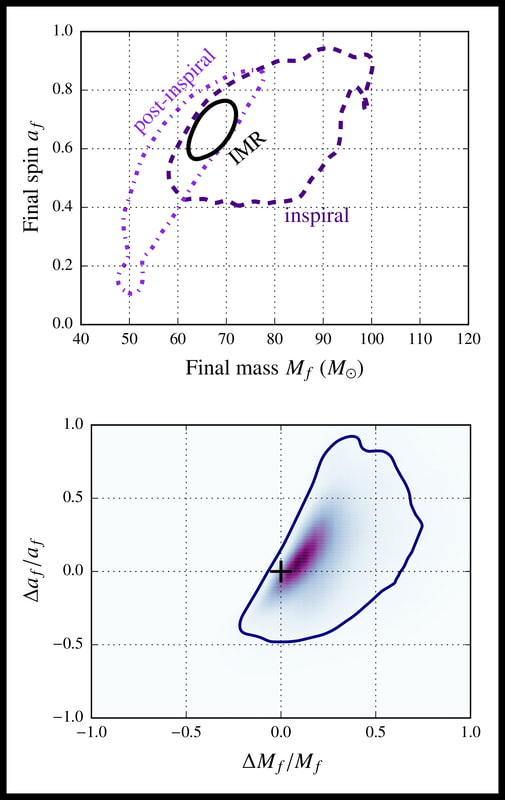
More than a century after he wrote them down with a pen, in the dark, with no gravitational-wave detector anywhere in his imagination — Einstein’s equations are still passing every exam we can devise, even in the most extreme corners of the universe we can reach.